Showing posts with label birds. Show all posts

Wednesday, September 17, 2014

A Coastal Triathlete: Brown Pelican

Photo taken by Cindy Elder
If you've ever taken an auto trip, you've probably seen bicyclists riding closely behind each other in a straight line. This technique, called a "pace line," allows the riders an opportunity to "draft" the cyclist just in front, cutting down wind resistance for subsequent riders. And if you've walked one of our beaches you probably have seen brown pelicans, Pelecanus occidentalis, flying in a similar formation. What those pelicans do instinctively takes most bicyclists weeks or months to perfect. For a brown pelican that can weigh up to 15 pounds, it's truly an energy-saving technique, allowing these birds to ride the marine air currents, rising and falling with the waves, with minimum effort.


Brown pelicans can be found from the coasts and estuaries of the mid-Atlantic and around the Gulf of Mexico. Some groups may migrate several hundred miles during the year, while others live their lives around the same shorelines. Whether they migrate or not, pelicans are never far from land and relatively shallow water depths. These are the areas in which they feed and breed. And if you think the pelican pace line is a pretty savvy way to get around, you'll be impressed at their fishing technique. A pelican's method of catching fish can be compared to a defensive end's approach to tackling the runner in a football game. Both dive right at their target with head tucked, and in the case of the pelican, with a slight rotation to the left (to protect the trachea on the right side of the bird's neck). The impact of the hit stuns the target (in the football game it at least shuts down the ball's advance toward the goalposts). The pelican's goal is to consume the fish knocked unconscious by the force of its collision with the water. Both the defensive end and the pelican have their protective equipment. Shoulder pads and a helmet for the man, air sacs beneath the pelican's skin that inflate like little air bags.
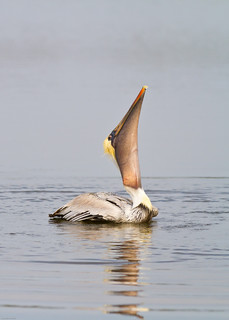
P. occidentalis is not a dainty eater; it expands its trachea, quickly taking in both fish and water before the fish recover from the blow. Nearby seagulls flock to the dive site, knowing the pelican must open its bill upon surfacing in order to rid itself of the water before swallowing its meal. The gulls will attempt to literally snatch the food out of the pelican's mouth; the ensuing scramble is reminiscent of the post-play pile-ons so commonly seen in football. Considering how last Sunday's game went against the Eagles, our Jacksonville Jaguars might benefit from a lesson in tackling given by P. occidentalis.

Come to the GTM Research Reserve's Family ecoMENTALITY National Estuaries Day on September 27 and you'll be able to watch this triathlete's skill: flying, and fishing, and the diving play-by-plays of pelican vs. gull right at the estuary's line of scrimmage.

Resources

Wednesday, August 27, 2014

The Mosquito's Fall Love Song

August is prime mosquito breeding season, and northeast Florida is in the bull’s-eye with over forty species calling this area "home." There are a number of myths about mosquitoes, including the mistaken idea that they can transmit HIV. They can't. There are a number of very problematic illnesses they can transmit, including Eastern Equine Encephalitis (EEE) from the virus (EEEV) by that same name. EEEV can infect both humans and horses. The salt marsh mosquito (Aedes sollicitans) is one vector of transmission, and this particular species is a difficult one to control given its life-cycle.

A. sollicitans is found in salt marshes. Like other female mosquitoes, the salt marsh mosquito needs a protein-rich feeding in order to lay eggs. Typically the female A. sollicitans seeks blood from a mammalian source, including humans and horses. After she has fed she can travel for miles looking for a low-lying, but dry patch of ground in a salt marsh. The eggs need four or five days of dry warm weather, then must be inundated by water that the next very high tide washes in. Eggs laid in the fall can overwinter awaiting the next favorable condition for hatching. The resulting larvae feed and molt several times, then enter a pupal stage before emerging as an adult. Depending upon temperature and other conditions, the mosquito's life cycle can last anywhere from a few days to two weeks. Since the salt marsh mosquito breeds in marshy areas, it is impractical for humans to control its breeding. Mosquito Control Districts, such as Anastasia, use chemical means to reduce populations.

As of this writing, there have been no known human or equine cases of EEEV in St. Johns County. Clay has had several equine cases, despite the fact that there is a veterinary vaccine for the disease. Unlike some species of mosquito, the salt marsh mosquito cannot host the EEEV. It can only transmit the virus after coming in contact with an infected bird. (If A. sollicitans cannot find a mammal, it will obtain blood feeding from a bird.) Because birds act as virus reservoirs, they can serve as indicators that the EEEV is present in a given area, and therefore, transmittable to humans or animals. Typically chickens are used as "sentinels" since they can be sequestered during the summer months and periodically tested for virus antibodies. These "canaries in a coal mine" are our first warnings to take serious precautions against getting bitten. However, precautions are prudent year-round in Florida. So when enjoying this beautiful fall weather on the GTM Research Reserve trails don't forget to bring effective insect repellent and protective clothing!

Now for two weird facts about mosquitoes.
  1. They do not have lungs: they breathe through openings in their chest or abdominal exoskeletons. 
  2. They "harmonize" their wing beats as part of the mating ritual. Yes, that annoying whine is music to a mosquito's ears. In the case of a related species, A. aegypti, the male slows its 600 beats-per-second (bps) while the female increases her 400-bps so they produce a combined total of 1200 bps: the perfect love song. After mating the female will be ready for her "protein drink" - preferably fresh blood. This mating and breeding behavior has inspired some scientists to call it the "Whine and Dine". It's possible that away might be found to disrupt the whining that initiates mating. Perhaps if more mosquitoes were tone-deaf we could reduce the need for our Mosquito Control District's services and still prevent mosquito-borne diseases.


Sources
http://www.coj.net/departments/neighborhoods/mosquito-control/common-mosquitoes.aspx

http://www.nmca.org/PAPER17.htm

http://www.amcdsjc.org

http://wwwnc.cdc.gov/eid/article/16/12/pdfs/10-0640.pdf

http://www.cdc.gov/EasternEquineEncephalitis/tech/factSheet.html

http://www.floridahealth.gov/diseases-and-conditions/mosquito-borne diseases/_documents/2014/week34arbovirusreport-8-23-14.pdf

http://www.wired.com/2009/01/mosquitowings/