Showing posts with label salt marsh. Show all posts

Wednesday, October 15, 2014

Honeymooning with the Fiddler Crab


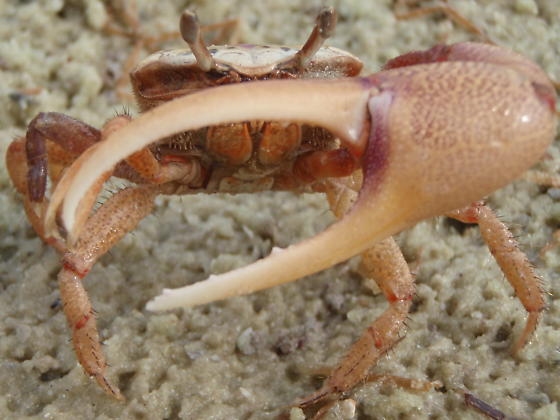
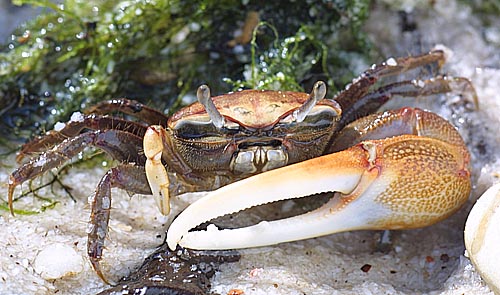
Florida beaches and marshlands are home to three species of fiddler crab, the sand fiddler (Uca pugilator), the mud fiddler (Uca pugnax) and the red-jointed or brackish water fiddler (Uca minax), in the order Decopoda – meaning 10-legs. Two of these “legs” – the front ones – are adapted as claws, however. The males are easily identified by their one oversized front claw, which can weigh up to one-third of the crab’s total. Accounts differ as to the origin of the name, “fiddler.” One explanation claims the name came from the use these crabs make of their smaller front claw to eat. The motion of picking up its food, depositing it in its mouth, and placing discarded bits back on the ground resembles the bow action of a fiddler. The male’s one outsized claw is useless for that purpose; he eats (or fiddles with his food) one-handed, while the female is free to gobble her meal with both hands.

The adult fidder’s notion of “food” includes the algae, bacteria, fungus, and decaying matter in sand, which the crab picks up with the “eating claw”. Edible material is separated from sand in the mouth; the discarded “sandballs” are deposited back on the ground. Because of this diet, fiddlers are important as regulators of bacteria and fungus in beach and marsh. The tunnels they dig in the intertidal zones and mud flats provide them with shelter when the tides rise and also aerate the ground, further ensuring the health of those soils.

With such a large claw, you’d think that the male fiddler would be an aggressive fighter, but not so. That large claw is better adapted to waving than fighting. One male waves it at another potentially threatening male to intimidate it; this waving seldom progresses to the fighting stage. The larger the claw and the more vigorous the wave, the better the chance of intimidating one’s opponent. If the crabs do engage in physical combat, the vanquished crab risks losing that precious claw and having to regrow another, which never reaches the size of the first.

Size matters, not only in deterring threats, but in attracting females. A male will use his large claw to dig a spacious “honeymoon suite” for his intended; the bigger the claw, the bigger the suite. Once the suite is dug, the male will station himself at the entrance and wave that claw at passing females, signaling his vitality with his healthy waving motion. If he catches a female’s eye, he will “dance” toward her and retreat back to his suite. If she takes a few steps in his direction, he taps on the wall of his burrow, so there is no mistaking his intentions. He waves again and repeats the dance of approach, retreat, and tapping the entrance – each time enticing the female closer until she finally follows him in. He then seals the entrance with mud, and mates with her. The couple stays in their honeymoon suite for two weeks, at which time the female’s eggs have gestated. She leaves the love nest to deposit her eggs, while he prepares his “digs” for another “wave” of wooing the next “lucky lady”. The male’s courtship behavior has earned it another nickname – the “calling crab.” And while it seems that for a female, her mate’s claw size does count, it may not be that simple. Research has shown that the size of the “honeymoon suite” influences its internal temperature, and that temperature influences egg gestation. The bigger the claw, the bigger the construction, and the more suitable the temperature might be. Perhaps the male’s tapping helps the female judge the size of the accommodations. She may be judging the spaciousness of the digs as much as she’s sizing him up. With summer and the mating season over, you might be able to spot the resulting juvenile fiddlers as well as their very tired parents at the GTM Research Reserve.

Resources

Wednesday, August 27, 2014

The Mosquito's Fall Love Song

August is prime mosquito breeding season, and northeast Florida is in the bull’s-eye with over forty species calling this area "home." There are a number of myths about mosquitoes, including the mistaken idea that they can transmit HIV. They can't. There are a number of very problematic illnesses they can transmit, including Eastern Equine Encephalitis (EEE) from the virus (EEEV) by that same name. EEEV can infect both humans and horses. The salt marsh mosquito (Aedes sollicitans) is one vector of transmission, and this particular species is a difficult one to control given its life-cycle.

A. sollicitans is found in salt marshes. Like other female mosquitoes, the salt marsh mosquito needs a protein-rich feeding in order to lay eggs. Typically the female A. sollicitans seeks blood from a mammalian source, including humans and horses. After she has fed she can travel for miles looking for a low-lying, but dry patch of ground in a salt marsh. The eggs need four or five days of dry warm weather, then must be inundated by water that the next very high tide washes in. Eggs laid in the fall can overwinter awaiting the next favorable condition for hatching. The resulting larvae feed and molt several times, then enter a pupal stage before emerging as an adult. Depending upon temperature and other conditions, the mosquito's life cycle can last anywhere from a few days to two weeks. Since the salt marsh mosquito breeds in marshy areas, it is impractical for humans to control its breeding. Mosquito Control Districts, such as Anastasia, use chemical means to reduce populations.

As of this writing, there have been no known human or equine cases of EEEV in St. Johns County. Clay has had several equine cases, despite the fact that there is a veterinary vaccine for the disease. Unlike some species of mosquito, the salt marsh mosquito cannot host the EEEV. It can only transmit the virus after coming in contact with an infected bird. (If A. sollicitans cannot find a mammal, it will obtain blood feeding from a bird.) Because birds act as virus reservoirs, they can serve as indicators that the EEEV is present in a given area, and therefore, transmittable to humans or animals. Typically chickens are used as "sentinels" since they can be sequestered during the summer months and periodically tested for virus antibodies. These "canaries in a coal mine" are our first warnings to take serious precautions against getting bitten. However, precautions are prudent year-round in Florida. So when enjoying this beautiful fall weather on the GTM Research Reserve trails don't forget to bring effective insect repellent and protective clothing!

Now for two weird facts about mosquitoes.
  1. They do not have lungs: they breathe through openings in their chest or abdominal exoskeletons. 
  2. They "harmonize" their wing beats as part of the mating ritual. Yes, that annoying whine is music to a mosquito's ears. In the case of a related species, A. aegypti, the male slows its 600 beats-per-second (bps) while the female increases her 400-bps so they produce a combined total of 1200 bps: the perfect love song. After mating the female will be ready for her "protein drink" - preferably fresh blood. This mating and breeding behavior has inspired some scientists to call it the "Whine and Dine". It's possible that away might be found to disrupt the whining that initiates mating. Perhaps if more mosquitoes were tone-deaf we could reduce the need for our Mosquito Control District's services and still prevent mosquito-borne diseases.


Sources
http://www.coj.net/departments/neighborhoods/mosquito-control/common-mosquitoes.aspx

http://www.nmca.org/PAPER17.htm

http://www.amcdsjc.org

http://wwwnc.cdc.gov/eid/article/16/12/pdfs/10-0640.pdf

http://www.cdc.gov/EasternEquineEncephalitis/tech/factSheet.html

http://www.floridahealth.gov/diseases-and-conditions/mosquito-borne diseases/_documents/2014/week34arbovirusreport-8-23-14.pdf

http://www.wired.com/2009/01/mosquitowings/