Showing posts with label research. Show all posts

Wednesday, October 15, 2014

Honeymooning with the Fiddler Crab


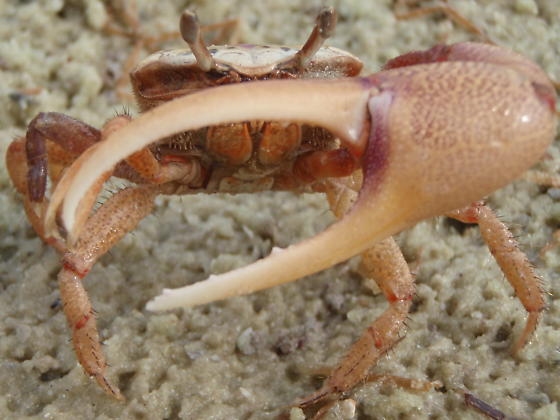
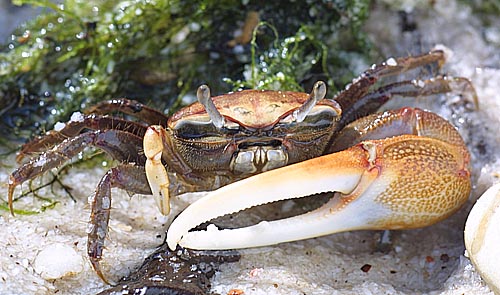
Florida beaches and marshlands are home to three species of fiddler crab, the sand fiddler (Uca pugilator), the mud fiddler (Uca pugnax) and the red-jointed or brackish water fiddler (Uca minax), in the order Decopoda – meaning 10-legs. Two of these “legs” – the front ones – are adapted as claws, however. The males are easily identified by their one oversized front claw, which can weigh up to one-third of the crab’s total. Accounts differ as to the origin of the name, “fiddler.” One explanation claims the name came from the use these crabs make of their smaller front claw to eat. The motion of picking up its food, depositing it in its mouth, and placing discarded bits back on the ground resembles the bow action of a fiddler. The male’s one outsized claw is useless for that purpose; he eats (or fiddles with his food) one-handed, while the female is free to gobble her meal with both hands.

The adult fidder’s notion of “food” includes the algae, bacteria, fungus, and decaying matter in sand, which the crab picks up with the “eating claw”. Edible material is separated from sand in the mouth; the discarded “sandballs” are deposited back on the ground. Because of this diet, fiddlers are important as regulators of bacteria and fungus in beach and marsh. The tunnels they dig in the intertidal zones and mud flats provide them with shelter when the tides rise and also aerate the ground, further ensuring the health of those soils.

With such a large claw, you’d think that the male fiddler would be an aggressive fighter, but not so. That large claw is better adapted to waving than fighting. One male waves it at another potentially threatening male to intimidate it; this waving seldom progresses to the fighting stage. The larger the claw and the more vigorous the wave, the better the chance of intimidating one’s opponent. If the crabs do engage in physical combat, the vanquished crab risks losing that precious claw and having to regrow another, which never reaches the size of the first.

Size matters, not only in deterring threats, but in attracting females. A male will use his large claw to dig a spacious “honeymoon suite” for his intended; the bigger the claw, the bigger the suite. Once the suite is dug, the male will station himself at the entrance and wave that claw at passing females, signaling his vitality with his healthy waving motion. If he catches a female’s eye, he will “dance” toward her and retreat back to his suite. If she takes a few steps in his direction, he taps on the wall of his burrow, so there is no mistaking his intentions. He waves again and repeats the dance of approach, retreat, and tapping the entrance – each time enticing the female closer until she finally follows him in. He then seals the entrance with mud, and mates with her. The couple stays in their honeymoon suite for two weeks, at which time the female’s eggs have gestated. She leaves the love nest to deposit her eggs, while he prepares his “digs” for another “wave” of wooing the next “lucky lady”. The male’s courtship behavior has earned it another nickname – the “calling crab.” And while it seems that for a female, her mate’s claw size does count, it may not be that simple. Research has shown that the size of the “honeymoon suite” influences its internal temperature, and that temperature influences egg gestation. The bigger the claw, the bigger the construction, and the more suitable the temperature might be. Perhaps the male’s tapping helps the female judge the size of the accommodations. She may be judging the spaciousness of the digs as much as she’s sizing him up. With summer and the mating season over, you might be able to spot the resulting juvenile fiddlers as well as their very tired parents at the GTM Research Reserve.

Resources

Wednesday, September 17, 2014

A Coastal Triathlete: Brown Pelican

Photo taken by Cindy Elder
If you've ever taken an auto trip, you've probably seen bicyclists riding closely behind each other in a straight line. This technique, called a "pace line," allows the riders an opportunity to "draft" the cyclist just in front, cutting down wind resistance for subsequent riders. And if you've walked one of our beaches you probably have seen brown pelicans, Pelecanus occidentalis, flying in a similar formation. What those pelicans do instinctively takes most bicyclists weeks or months to perfect. For a brown pelican that can weigh up to 15 pounds, it's truly an energy-saving technique, allowing these birds to ride the marine air currents, rising and falling with the waves, with minimum effort.


Brown pelicans can be found from the coasts and estuaries of the mid-Atlantic and around the Gulf of Mexico. Some groups may migrate several hundred miles during the year, while others live their lives around the same shorelines. Whether they migrate or not, pelicans are never far from land and relatively shallow water depths. These are the areas in which they feed and breed. And if you think the pelican pace line is a pretty savvy way to get around, you'll be impressed at their fishing technique. A pelican's method of catching fish can be compared to a defensive end's approach to tackling the runner in a football game. Both dive right at their target with head tucked, and in the case of the pelican, with a slight rotation to the left (to protect the trachea on the right side of the bird's neck). The impact of the hit stuns the target (in the football game it at least shuts down the ball's advance toward the goalposts). The pelican's goal is to consume the fish knocked unconscious by the force of its collision with the water. Both the defensive end and the pelican have their protective equipment. Shoulder pads and a helmet for the man, air sacs beneath the pelican's skin that inflate like little air bags.

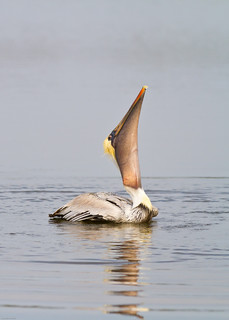
P. occidentalis is not a dainty eater; it expands its trachea, quickly taking in both fish and water before the fish recover from the blow. Nearby seagulls flock to the dive site, knowing the pelican must open its bill upon surfacing in order to rid itself of the water before swallowing its meal. The gulls will attempt to literally snatch the food out of the pelican's mouth; the ensuing scramble is reminiscent of the post-play pile-ons so commonly seen in football. Considering how last Sunday's game went against the Eagles, our Jacksonville Jaguars might benefit from a lesson in tackling given by P. occidentalis.

Come to the GTM Research Reserve's Family ecoMENTALITY National Estuaries Day on September 27 and you'll be able to watch this triathlete's skill: flying, and fishing, and the diving play-by-plays of pelican vs. gull right at the estuary's line of scrimmage.

Resources

Wednesday, July 2, 2014

Respect the Turkey!

This week we observe the 238th birthday of American Independence. In this modern era it is commonly believed that if one of the signers of the Declaration of Independence had had his way, we'd be celebrating, not the American eagle, but the American turkey, as our national bird. Benjamin Franklin is thought to have preferred that the North American turkey rather than the eagle be depicted on the Presidential Seal, and that he justified his preference on the turkey's uniquely indigenous status and upon its "moral superiority" to the eagle. Not exactly. The elder statesman expressed his opinions on the subject in a letter to his daughter saying, “For my own part I wish the Bald Eagle had not been chosen the Representative of our Country. He is a Bird of bad moral Character. He does not get his Living honestly." He continued, "... the Turkey is in Comparison a much more respectable Bird, and withal a true original Native of America… He is besides, though a little vain & silly, a Bird of Courage." He added that the eagle on the seal looked "more like a turkey," and that observation pleased him. Thus, the seeds of confusion were sown. The popular belief has taken such deep root that even the National Geographic reports the myth. According to the Franklin Institute, Ben's choice for the national seal had no bird on it whatsoever.

But let's take a moment to understand the wild turkey's "respectable" qualities, and to examine Franklin's claim to its status as "a true original Native of America." Keep in mind, this is the North American wild turkey, Meleagris gallopavo, not the behemoth domesticated turkey that dominates our Thanksgiving tables. Domesticated turkeys have a more "complicated" lineage. They are the products of intensive breeding to produce a hefty bird with plenty of breast meat. The birds are so large they can hardly walk, let alone reproduce; artificial insemination takes care of that function, and ensures a standard-unit gargantuan turkey as its result.

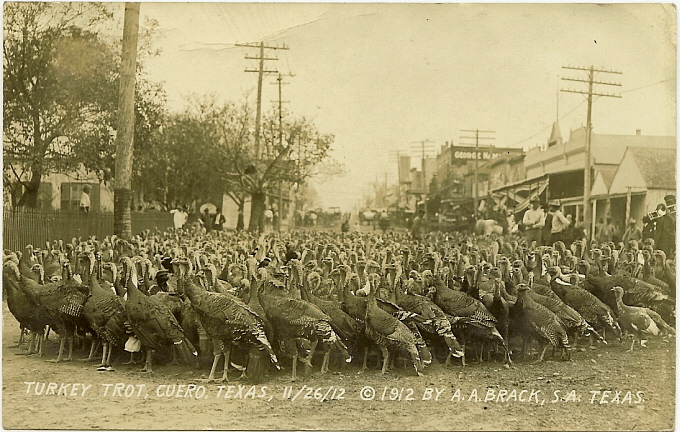
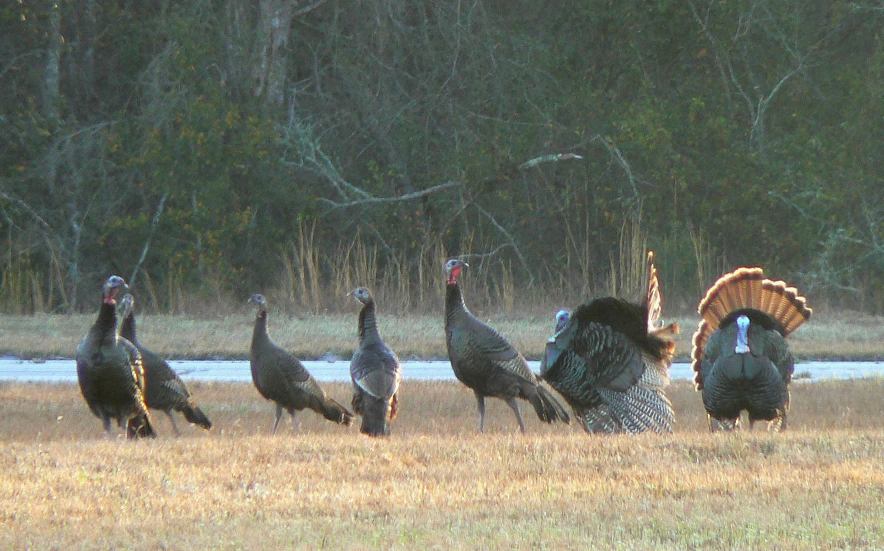
In contrast, North American wild gobblers (male turkeys) weigh only a third of their farm-bred brethren, between 16-24 pounds; females average 8-12 pounds. One or more subspecies of wild turkey occupies every state in the continental US, and parts of Canada and Mexico. It's hard to believe that these birds were on the brink of extinction in the 1930's, but thanks to conservation efforts, especially those of hunters, they have made a dramatic comeback. The Eastern wild turkey, M. gallopavo silvestris, has the widest distribution, from Canada to north Florida and west of the Mississippi. Florida has its own subspecies, M. gallopavo osceola. Named after the Seminole chief, Osceola, this bird occupies the panhandle, and depending upon which source you reference, the counties south of Duval. Three other subspecies occupy states from the mid-West to the West Coast. Whatever the experts say, a turkey goes where it pleases. Which is why turkeys were herded just like cattle when brought to market, back in the 1800's.
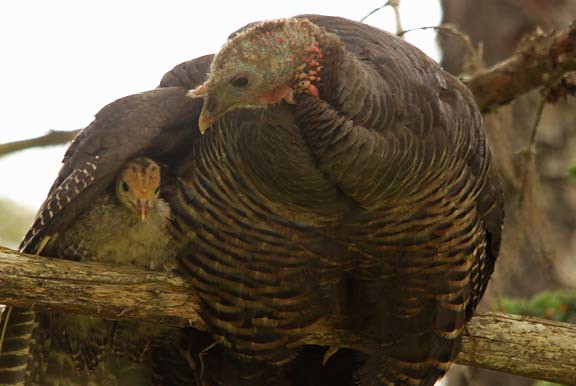
Turkeys are social creatures; within a flock, each individual has its own "pecking order," no pun intended. They have a wide variety of vocalizations used to communicate danger, pleasure, and communion to each other. When a group of them gets together at night they can sound like a heathen cult celebrating a sylvan festival. So much for a simple, "gobble-gobble." A mother turkey will vocalize to her chicks, making clucking sounds before they hatch to help them imprint on her, thus aiding her instruction of them in basic survival techniques. Sounds like a pretty respectable critter so far.

While the domestic turkey is physically incapable of the act of reproduction, the male wild turkey takes this responsibility very seriously. During breeding season, males become more colorful; the head and feathers may undergo several color changes. Their waddle and the tubular snood that drapes its bill enlarge and brighten. They also vocalize and dance while fanning out their tail feathers. All to attract the drab little females.

At the author's home, the breeding season for our own backyard visitors takes on a bar-scene atmosphere. The dominant gobbler will clear a circular patch of ground for his performance stage. Within it he will dance and fan his feathers in a display that is obviously proof of his physical stamina. The ladies will stare across the pond with their backs to him, in feigned indifference. When the excitement gets too much for one damsel, she will try to break away from the group and sneak off with her Romeo. It's then that the turkey pecking-order becomes evident. The dominant female will hustle off to collect the wayward bird and bring her back to the fold. After a respectable amount of time elapses, the dominant female then struts over to his highness and they leave the scene together. He'll be back for the others later. Meanwhile the immature males are running circles around any female in sight, hoping perhaps to exhaust her into submission. Try again next year, sonny.

At least Franklin's notion that the turkey is a true New World indigenous animal must be correct. Not entirely, as it turns out. Until Europeans arrived in the New World there were two species of native American birds: one in Central America and another ranging into Canada. When the Spanish encountered native peoples raising the Central American species, they mistakenly believed them to be a variety of grouse from Turkey and misnamed them "turkeys." They brought the New World birds back to the Old and bred them; 200 years later the colonists reintroduced them to the Americas as domesticated animals. Farmyard turkeys are hardly the true native originals Franklin thought them to be.

European Americans had no corner on myths about the turkey. Native Americans had many stories involving turkeys or explaining aspects of their appearance or behavior. Turkeys could be tricksters and thieves, or noble characters that aided people in distress. Feathers and other parts of the bird could convey special powers on the human wearer.

So, the eagle never was in danger of losing its status as the official bird of the United States. Just as well, too. When Apollo 11 made the first manned visit to the moon, the crew landed in a vessel named for our national bird. How very different the report from Neil Armstrong, "The Eagle has landed," would have sounded if our national bird had been the turkey.

Enjoy the 4th of July, but please remember all those fireworks cause wild turkeys, eagles, and other creatures a great deal of stress - not to mention the hazards of explosives and the post-celebration litter. Even if the turkey is not the noble creature of Franklin's estimation, it and its fellow creatures deserve our respect on holidays and every day. And decide for yourself which of these birds has the better "character" - read our April 9 Facebook post on the eagle as a National Symbol.


Wednesday, June 4, 2014

He Moves in Mysterious Ways

We’re now in the last three week of our marathon celebration of pollinators, culminating in the GTM’s National Pollinator Festival on Saturday, 6/21. Weird Animal Wednesdays has covered one representative from the butterfly, moth, bat, and bee categories. Well this week, we’re going to the birds to look at that engineering marvel, the tiny hummingbird. Florida is visited by at least ten species of hummers, many of whom migrate to Central America during cold weather, traveling for distances of up to 500 miles between “rest stops”.

You’ve probably seen hummingbirds visiting a vining or bushy collection of flowers, darting from one to another in the blink of an eye. High sucrose nectar powers them. Hummingbirds drink several times their body weight daily. Their long, forked tongues can form two tubes, uncurling to immerse into the nectar, and curling up to capture it. Pollination is incidental. Hummingbirds hover when visiting a flower, much like bees or other insects. With an almost vertical feeding position, it is no surprise that these animals prefer flowers that have relatively flat vertical faces; hummingbird feeders deliver their nectar from such designs. But hummingbirds also visit flowers that hang downwards, hovering in a rather awkward position to do so. Scientists speculate that such flowers are visited because their nectars is well-protected from dilution by rain.

Hummingbirds are in the family, trochilidae, meaning “small bird”. The name might be accurate, but it hardly does this little creature justice. The hummingbird’s unique physiology and flight technique are much closer to that of insects such as bees or hawkmoths, which, as you may remember from a previous Weird Animal edition, were real speedsters. These insects fly with more efficiency because both the down stroke and the upstroke provide lift. Hovering insect wings are supremely flexible, turning inside out with the flying process. Hummingbirds’ wings don’t exhibit that much rotation but they can turn sideways during the flight stroke. Think about how you tread water when your body is vertical. The hummer’s wing movements resemble your arm strokes to keep yourself stationary and erect. This efficiency means the bird uses less energy to fly than its larger counterparts whose wings flap up and down from a shoulder-like appendage. Nonetheless, a hummingbird spends much of its time perching. Flight is reserved for obtaining nectar and catching insects to augment their protein requirements – and for mating rituals.

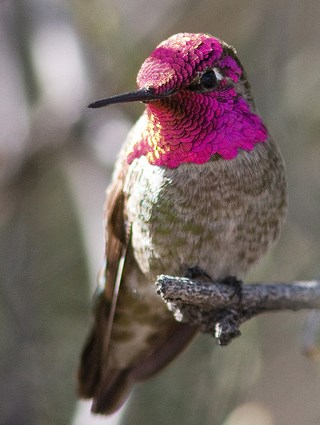
Mating displays and rituals are where the male hummingbird “shines”. Not only does the male of the species sport an iridescent jeweled coat, but he performs incredible acrobatic feats to prove himself the fittest and win the fair heart of the drabber female. The courtship behavior of Anna’s hummingbird (Calypte anna) has been extensively studied; other species have similar behaviors and feather structures so it seems a safe bet that they use a routine similar to Anna’s to impress a female. During breeding season, male hummingbirds will search for perching females. When he finds a likely spectator he’ll fly straight up, perhaps as high as… feet. Then the bird will tuck back its wings and dive headfirst. At the last second, the descending male fans out his tail features, stopping his fall. He then pulls back the feathers and pulls out of his dive. The sound his tail feathers make in the onrushing wind creates a distinctive chirp, which the female evaluates for its desirable qualities. What is she looking for? First of all, since each species of hummingbird produces a distinctive “tail song” she wants to be sure her potential mate is the same as she is. Then she looks for volume. The louder the sound, the faster the male was falling. It takes a strong male to achieve the highest speeds (and live through it). This is no casual trick. A descending Anna’s hummer can reach speeds over 50MPH – so fast the velocity could rip the bird’s wings off were the chest muscles not able to draw them back out of the friction zone. Measured in terms of the hummingbird’s size this descent is faster than a jet pilot. Pulling out of the fall takes tremendous strength and the ability to withstand up to10 G’s of force; 7 G’s can cause humans to black out. Hummingbirds can pull out so quickly, however, that these forces are only active for a microsecond, thus minimizing the danger to the bird.

Adult male Anna's Hummingbird. Photo taken
by Joan Gellatly, AZ Feb 2009.
If his display impresses her, she may acquiesce. Then, his job is done. On to the next death-defying maneuver to win another feminine heart. After the tryst, the female’s job begins. She builds a lichen nest lined with soft material connected with carefully harvested spiders’ webs. Two voracious chicks emerge from the eggs she lays and now she has three mouths to feed. If the nesting took place in our neck of the woods, it’s time for the family to migrate south.

If you enjoy hummingbird visits, install some of their favorite nectar plants in your yard. See the links below. While it is tempting to hang a feeder for them, your visitors will be less stressed feeding nature’s way. A bird feeder invites competition and fighting in this territorial little creature. And remember, our hummingbirds need to head south for the winter. Keeping your feeder up too long will encourage them to stay and risk freezing to death. Flowers know when to begin and to stop blooming, and that will tell your hummers to depart on time and be back with the weather is favorable.

For some cool videos and more information check out the following links: