Showing posts with label florida. Show all posts

Wednesday, September 17, 2014

A Coastal Triathlete: Brown Pelican

Photo taken by Cindy Elder
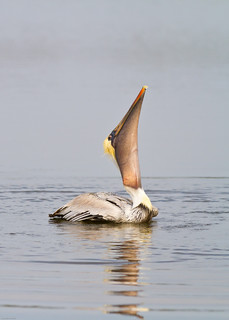
If you've ever taken an auto trip, you've probably seen bicyclists riding closely behind each other in a straight line. This technique, called a "pace line," allows the riders an opportunity to "draft" the cyclist just in front, cutting down wind resistance for subsequent riders. And if you've walked one of our beaches you probably have seen brown pelicans, Pelecanus occidentalis, flying in a similar formation. What those pelicans do instinctively takes most bicyclists weeks or months to perfect. For a brown pelican that can weigh up to 15 pounds, it's truly an energy-saving technique, allowing these birds to ride the marine air currents, rising and falling with the waves, with minimum effort.


Brown pelicans can be found from the coasts and estuaries of the mid-Atlantic and around the Gulf of Mexico. Some groups may migrate several hundred miles during the year, while others live their lives around the same shorelines. Whether they migrate or not, pelicans are never far from land and relatively shallow water depths. These are the areas in which they feed and breed. And if you think the pelican pace line is a pretty savvy way to get around, you'll be impressed at their fishing technique. A pelican's method of catching fish can be compared to a defensive end's approach to tackling the runner in a football game. Both dive right at their target with head tucked, and in the case of the pelican, with a slight rotation to the left (to protect the trachea on the right side of the bird's neck). The impact of the hit stuns the target (in the football game it at least shuts down the ball's advance toward the goalposts). The pelican's goal is to consume the fish knocked unconscious by the force of its collision with the water. Both the defensive end and the pelican have their protective equipment. Shoulder pads and a helmet for the man, air sacs beneath the pelican's skin that inflate like little air bags.

P. occidentalis is not a dainty eater; it expands its trachea, quickly taking in both fish and water before the fish recover from the blow. Nearby seagulls flock to the dive site, knowing the pelican must open its bill upon surfacing in order to rid itself of the water before swallowing its meal. The gulls will attempt to literally snatch the food out of the pelican's mouth; the ensuing scramble is reminiscent of the post-play pile-ons so commonly seen in football. Considering how last Sunday's game went against the Eagles, our Jacksonville Jaguars might benefit from a lesson in tackling given by P. occidentalis.

Come to the GTM Research Reserve's Family ecoMENTALITY National Estuaries Day on September 27 and you'll be able to watch this triathlete's skill: flying, and fishing, and the diving play-by-plays of pelican vs. gull right at the estuary's line of scrimmage.

Resources

Wednesday, August 27, 2014

The Mosquito's Fall Love Song

August is prime mosquito breeding season, and northeast Florida is in the bull’s-eye with over forty species calling this area "home." There are a number of myths about mosquitoes, including the mistaken idea that they can transmit HIV. They can't. There are a number of very problematic illnesses they can transmit, including Eastern Equine Encephalitis (EEE) from the virus (EEEV) by that same name. EEEV can infect both humans and horses. The salt marsh mosquito (Aedes sollicitans) is one vector of transmission, and this particular species is a difficult one to control given its life-cycle.

A. sollicitans is found in salt marshes. Like other female mosquitoes, the salt marsh mosquito needs a protein-rich feeding in order to lay eggs. Typically the female A. sollicitans seeks blood from a mammalian source, including humans and horses. After she has fed she can travel for miles looking for a low-lying, but dry patch of ground in a salt marsh. The eggs need four or five days of dry warm weather, then must be inundated by water that the next very high tide washes in. Eggs laid in the fall can overwinter awaiting the next favorable condition for hatching. The resulting larvae feed and molt several times, then enter a pupal stage before emerging as an adult. Depending upon temperature and other conditions, the mosquito's life cycle can last anywhere from a few days to two weeks. Since the salt marsh mosquito breeds in marshy areas, it is impractical for humans to control its breeding. Mosquito Control Districts, such as Anastasia, use chemical means to reduce populations.

As of this writing, there have been no known human or equine cases of EEEV in St. Johns County. Clay has had several equine cases, despite the fact that there is a veterinary vaccine for the disease. Unlike some species of mosquito, the salt marsh mosquito cannot host the EEEV. It can only transmit the virus after coming in contact with an infected bird. (If A. sollicitans cannot find a mammal, it will obtain blood feeding from a bird.) Because birds act as virus reservoirs, they can serve as indicators that the EEEV is present in a given area, and therefore, transmittable to humans or animals. Typically chickens are used as "sentinels" since they can be sequestered during the summer months and periodically tested for virus antibodies. These "canaries in a coal mine" are our first warnings to take serious precautions against getting bitten. However, precautions are prudent year-round in Florida. So when enjoying this beautiful fall weather on the GTM Research Reserve trails don't forget to bring effective insect repellent and protective clothing!

Now for two weird facts about mosquitoes.
  1. They do not have lungs: they breathe through openings in their chest or abdominal exoskeletons. 
  2. They "harmonize" their wing beats as part of the mating ritual. Yes, that annoying whine is music to a mosquito's ears. In the case of a related species, A. aegypti, the male slows its 600 beats-per-second (bps) while the female increases her 400-bps so they produce a combined total of 1200 bps: the perfect love song. After mating the female will be ready for her "protein drink" - preferably fresh blood. This mating and breeding behavior has inspired some scientists to call it the "Whine and Dine". It's possible that away might be found to disrupt the whining that initiates mating. Perhaps if more mosquitoes were tone-deaf we could reduce the need for our Mosquito Control District's services and still prevent mosquito-borne diseases.


Sources
http://www.coj.net/departments/neighborhoods/mosquito-control/common-mosquitoes.aspx

http://www.nmca.org/PAPER17.htm

http://www.amcdsjc.org

http://wwwnc.cdc.gov/eid/article/16/12/pdfs/10-0640.pdf

http://www.cdc.gov/EasternEquineEncephalitis/tech/factSheet.html

http://www.floridahealth.gov/diseases-and-conditions/mosquito-borne diseases/_documents/2014/week34arbovirusreport-8-23-14.pdf

http://www.wired.com/2009/01/mosquitowings/

Wednesday, August 13, 2014

Animal Connections - Eastern Indigo Snake

Eastern Indigo Snake

Drymarchon couperi, the Eastern indigo is the longest native snake in North America. Larger males can reach eight feet in length. Although it prefers tropical climates, the indigo extends its range throughout the Florida peninsula to southeastern Georgia by using the burrow holes of large animals such as the gopher tortoise (Gopherus polyphemus) during colder weather. Burrow holes are also important for indigos "shedding their skin" no matter what the latitude. And as the gopher tortoise species goes, so goes the Eastern indigo. Both are Threatened Species in at least one of the areas where they are found.

A burrow is a necessary, if temporary, shelter for this snake. It does not hibernate, but continues to hunt and feed outside the burrow throughout the year. And it dines on anything it can overpower, from fish to small mammals. It doesn't wait until its victim has expired - merely incapacitated. In short, it's not a fussy eater. It will even eat juvenile gopher tortoises (which seems a bit self-defeating). The indigo is not venomous, but it is resistant to the venom of snakes that are. An Eastern indigo can survive the bite of a copperhead or rattlesnake and subsequently consume either without ill effect. Not only is that trait advantageous, it's downright necessary because venomous snakes also take shelter in gopher tortoise burrows. There's only so much room down there...

If you've seen a picture of an indigo you might rightly wonder why it has the appellation, "indigo snake."
The scales of the snake refract sunlight to give its body a shimmery blue-black appearance, although that doesn't always show up in a photo. When seen in the shade, the iridescence is lost; and the snake looks like any other (large) black snake. The snake's taxonomic name, "Drymarchon," roughly translates into "forest ruler." Large and powerful as these animals are, it seems apt. Its other common names, "gopher snake," or "blue gopher," reflect its choice of gopher tortoise burrows for shelter.

Eastern indigos do not mature until three or four years of age - relatively late in the snake world. Females, when ready, will emit a pheromone to attract a male. If multiple males pick up on the scent then they battle for the female by intertwining their bodies trying to pin the other's head to the ground. Females lay about a dozen eggs, preferably in the shelter of an abandoned gopher tortoise burrow. The slow maturation rate of the Eastern indigo and its dependence upon the gopher tortoise for sources of shelter make resurgence of this species a complex goal. Snakes may not be on everyone's "favorites" list, but Eastern indigos, like all members of the Serpentes families, keep populations of smaller animals in check. Protecting its place in this world will involve allowing both the Eastern indigo and the gopher tortoise that benefits it sufficient habitat to survive.

Tuesday, August 5, 2014

A Rose is a Rose, is a Roseate Spoonbill

A Rose is a Rose, is a Roseate Spoonbill

If you've ever seen a flamingo in North Florida, you are mistaken. What you saw was a roseate spoonbill (Ajaja ajaja). Flamingos don't venture north of the Florida Keys. You might say the roseate spoonbill is North Florida's version of the flamingo. The flamingo and the roseate spoonbill look very much alike at first blush. Their rouge plumage is colored by the tiny pink crustaceans they both eat. It seems scarcely possible, however, that any other bird could look as comical as the long-legged, hook-billed flamingo. But the roseate spoonbill does. In fact it looks downright wacky. Imagine a pint-sized bald flamingo with an olive and tan pate and a black streak at the base of its skull, just above the feather line. And picture this three-foot avian looking like it ended up the worse for wear in a boxing match - that a first round knockout punch to its hooked bill had flattened it into a spatula. Now you're visualizing the roseate spoonbill.

But don't expect to laugh when you see one. Its amazingly beautiful plumage makes its silly face seem unimportant. A bill that would make a duck blush is more than compensated by its ruby-tipped wings, shoulders sporting a circle of orange feathers, and its pink and white plumed chassis. Seeing a spoonbill in flight, its 4-foot wingspan floating like a pink cloud against an azure sky, you could overlook the strange red eyes and a forehead not unlike Mr. Magoo's. Mrs. Magoo looks no different. Perhaps a tad more diminutive and a shade less rosy.

Its beauty and its whimsy aside, seeing one is so special because this bird has made an astounding comeback from the 30-40 breeding pairs that constituted its population in the 1930's. Fashionistas at the turn of the 20th century had been captivated by the bird's feathers and coveted them for ladies' fans. The fact that this appropriation shortened the bird's lifespan was of little regard. The demand for spoonbill feathers was assured because once the feather was removed from the bird, it was removed from the source of its coloration. Older spoonbill feathers faded, and new ones were sought to replace them. Luckily the bird was placed off limits to hunters when it was listed as an endangered species. And fashion being a fickle maiden, moved on to another craze.

Today there are thousands of nesting pairs of spoonbill in Florida and an abundance in Texas and Louisiana. Northern Florida is the extreme edge of its range. If you head over to the St. Augustine Alligator farm towards the end of March, you can see them swoop in droves to court, nest and raise their young. The photographers are already there, anticipating the spoonbills' arrival while snapping happily at wood storks, egrets, and herons. Amid this ruckus, the gregarious spoonbills pair up and share parental responsibilities for two months, until the fledglings are ready to leave the nest and the sanctuary of the Alligator Farm. (The alligators at the
Farm deter the typical spoonbill egg predators such as snakes and raccoons). After a steady diet of crustaceans and other delicacies, the young birds take on the trademark pink, orange, and red hues of adult spoonbills. And their bills flatten out to resemble those of their elders.

Keep an eye out for roseate spoonbills when visiting the GTM Research Reserve in warmer months. Its estuaries harbor the wide variety of small animals these birds consume. In addition to small crustaceans, spoonbills eat slugs, snails, small fish, and insects. They dine communally, and catch their meals by immersing their bills vertically while swishing them through the water. It's quite a sight to glimpse a group walking in unison back and forth in the water, heads swaying to and fro, snacking on what crosses their path. Their nostrils sit high up on their bills so they can breathe while foraging. If a small animal is within striking distance their pressure-sensitive bills alert them to the potential meal and snap it up. The water they wade through is often murky because the spoonbills intentionally agitate it to rouse their prey. They rely more on bill sensitivity than eyesight to score the next mouthful.

Colorful, sociable, and resilient, these wading birds are as striking as flamingos, and even droller. But they have retained one scrap of dignity that the flamingo lost. They haven't been made into lawn ornaments - yet.

Great Florida Birding and Wildlife Trail - Roseate Spoonbill

FWC - Roseate Spoonbill

St. Louis Zoo - Roseate Spoonbill

10 Fun Roseate Spoonbill Facts

Smithsonian National Zoological Park - Roseate Spoonbill

Wednesday, June 25, 2014

Amphibious Brain Freeze

Amphibious Brain Freeze

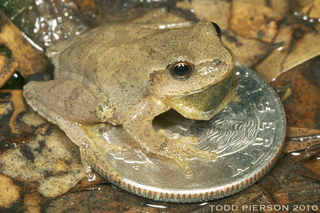
What does a tiny frog called the “Spring Peeper” have in common the 7-11 Slurpee marketed as “The Brain Freeze?” They both come frozen. Pseudacris crucifer is known by gardeners from the mid-Atlantic northward to be the auditory harbinger of spring – time to get planting! This nickel-sized amphibian is one of the first hibernating animals to wake up after a cold winter, and the males wake up singing for you-know-what. The amazing thing about the northern spring peeper is that it can wake up from a frozen state. P. crucifer is one of a few species in the animal kingdom capable of surviving several weeks as a frog popsicle. Its southern cousin, Pseudacris crucifer bartramiana, may share this amazing ability with the northern spring peeper, but Florida winters evidently haven’t put it to the test.

North of “The Land of the Flowers” frogs generally hibernate in areas protected from all but the harshest freezes: lake bottoms or deep under the ground. By contrast, northern spring peepers spend the winter on the forest floor camouflaged underneath moist leaf litter. When temperatures hover around freezing, stage one of the peeper’s hypothermic response kicks into gear. Reacting to near-freezing temperatures, the frog’s liver changes stored glycol into glucose, a form of sugar. By introducing glucose into the organs and circulatory system, the freezing point of the frog’s bodily fluids is lowered by several degrees. Remember our Brain Freeze Slurpee? The sugar in the beverage allows the drink to be super-cooled while not freezing solid (it helps that the liquid is constantly moving like cement in a mixer). When we drink this hyperchilled beverage, some of us experience the pain of a too-sudden exposure to its freezing temperatures, the famous Slurpee Brain Freeze. Prolonged exposure to freezing temperatures can harm and even kill humans.

But not so given the peeper’s hypothermic survival response: stage one prevents ice crystals from forming in the frog’s essential organs by pumping them full of glucose. That protects the frog down to about 27 degrees F. What happens then temperatures continue to fall? The second stage of the peeper response is to allow its body to freeze – but to do so in a controlled manner, doing the least potential damage to vital organs. As temperatures drop, the frog’s body adopts a triage strategy to its freezing process. It draws water out of the most vital organs and supercools the remaining fluids by absorbing solutes into the cell structures. Both measures minimize the formation of ice crystals that could rupture cells and organs. Less vital structures are allowed to freeze solid. After the frog has effectively been frozen, the heart stops. Any necessary energy consumption is performed anaerobically.

This controlled freeze-out is amazing, even weird. But even more remarkable is the thaw. The peeper must survive, indeed, return to life as a result of the process. So its meltdown can’t simply return the ice crystals in its body to a liquid state. The whole process must unwind itself precisely, starting by activating the vital organs simultaneously and ending with the glucose being converted back to glycol and returned to the liver. There are limits to this hypothermic response and reversal mechanism. External temperature drops must not be too dramatic; the frog needs time to engage the hypothermic response. Conversely, the heat up time cannot occur too quickly for the frog to reverse the chemistry it set into motion. A frog cannot remain in cryogenic suspension too long; the adaptation has a shelf life. And at super cold subzero temperatures, the response is ineffective – too many ice crystals will form and damage essential organs. Therefore, peepers cannot inhabit arctic or subarctic areas. The peeper’s freezing response is energy consumptive; harsh or prolonged winters even in temperate climes can be its demise. A frog can only mount so many hypothermic responses in one season before energy reserves give out. Hopefully, the spring thaw arrives before that happens.

Early spring imposes new demands on spring peepers. At least for males itching to mate, the demand is to peep. Females are listening for the loudest peeper that can also peep the most quickly. She can assess his fitness by these two qualities alone. The loudest peeps come from the biggest vocal sacs that only the heftiest individuals can sport. And a superfast peeper has to have remarkable breath control – fit enough to keep peeping long and fast without pausing to provide himself with oxygen. Once she has made her choice, the peepers dip into the lake for an intimate moment. Then they go their separate ways. She, to lay her eggs on a stem or twig underneath the water. He, to begin peeping another fair maiden.

Even though our southern spring peeper is not called upon to perform cryogenic feats, the male must still outdo his competitors in the chorus line. Whether north or south, the mechanics are the same. The frog fills its lungs with air, seals its nose and mouth and passes that air back and forth from the lungs over the larynx (that produces the sound) and into the vocal membrane. This membrane vibrates and acts like an amplifier. And size counts. The larger the frog, the larger the membrane. The larger the membrane, the louder the sound. Louder is better. In the spring the peeps of these frogs can be so loud, one wonders if an alien ship has landed near some body of water. Unlike the nocturnal northern peeper, all a southern fella needs to start peeping, day or night, is a good soaking rain. A healthy Florida rain can evoke a long and strong peeping behavior in P.c. bartramiana that predictably arouses the female.

When the last peep is peeped and the last egg deposited, northern peepers retire to woodland locales to lounge on lower branches, eat small insects, and await the coming winter. The randier southern peepers are better climbers. This subspecies spends its time in higher limbs catching flies, spiders, and other small insects, and vocalizing when the situation arises. Both peepers used to be classified as tree frogs, Hyla, until biologists posited them into the Pseudacris (false cricket) family of chorus frogs. Fertilized peeper eggs hatch into tadpoles in just under two weeks. After a few weeks of grazing in their aquatic environment, both northern and southern peeper tadpoles mature into adults, acquiring the brown “x” (crucifer) on their backs. The northerners join the other grown-ups in wooded areas, stocking up on proteins for the coming winter. In three years’ time, northern and southern males will be tuning up their vocal sacs in the hopes of gaining a lady’s favor.

Every July 11th, participating 7-11 stores offer free Slurpee (Brain Freeze) drinks to their customers. Maybe you’ll want to quaff one down to celebrate the northern spring peeper, the plucky amphibian with the big winter survival adaptation. Just don’t ask the store clerk for one in frog-flavor.

Last Saturday’s Pollinator Celebration was fun and informative. Mark your calendar for next year! In the meantime, if you want to continue your celebration of native pollinators, why not sign up as a monthly butterfly monitoring volunteer? And please do feed the pollinators! See the Unsung Heroes of Pollination article for tips on how to start a pollinator-friendly garden.